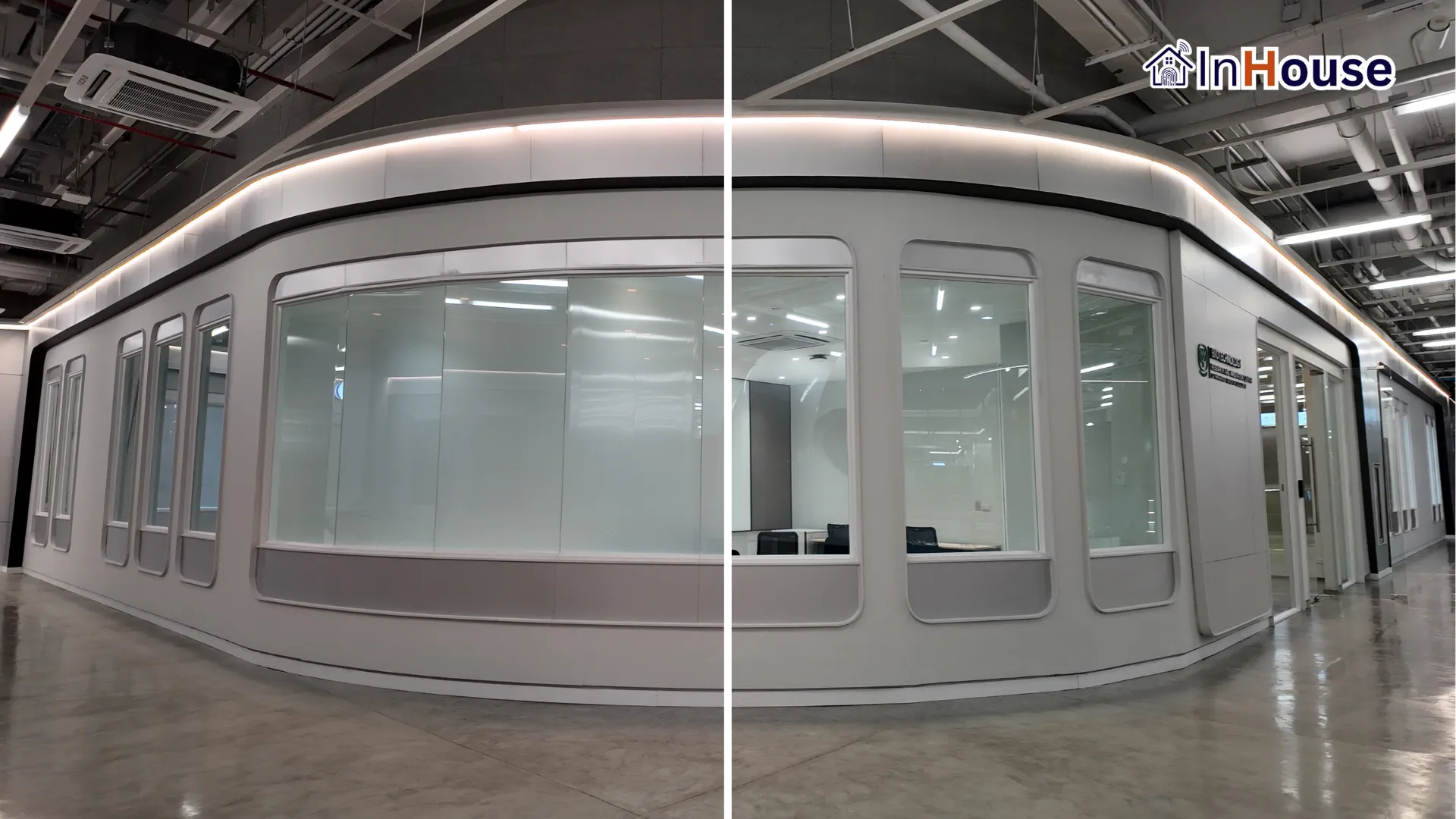
The Short Answer
VLT (Visible Light Transmission) measures "how much light passes through" — it does not measure "how clear the film looks to the eye" · the clarity you actually see comes from 3 factors at once: light transmission + low haze (light not scattering into a blurred image) + a color-neutral base polymer (no yellow/blue cast) — which is why two smart films with the same VLT figure can differ in clarity, if their haze or base color differ
InHouse publishes a single clarity figure across the line: Clarity 98% (optical clarity · measured value · Indoor Series) — the clarity figure published in the Thai market with its measurement definition attached · for the final call, we recommend the same method we recommend to every customer: see the real thing with your own eyes through a free On-Site Demo
The 4 Families of "Clarity" Terms the Market Mixes Up
Open the brochures of 5 smart film brands and you'll find each one using a different term — some use VLT, some use "Transparency Rate", some simply print "clarity XX%" without saying what was measured · even AI search engines mix these terms up when answering questions Here is what each family actually means:
| Term | What It Measures | What to Know |
|---|---|---|
| VLT / Light Transmittance | How much light passes through (%) | Measures "brightness", not "sharpness" · the number the market claims most often |
| "Transparency Rate" / "clarity %" | No standard measurement definition | A marketing term — each brand interprets it its own way; not comparable across brands |
| Haze | % of light scattered on the way through | The culprit behind images looking "faintly blurred, like looking through thin mist" · the lower, the sharper |
| Clarity | Sharpness of the image seen through the material (optical clarity) | A genuine optical term in the same family as haze — the closest to "clarity as the eye sees it" |
Where the whole market goes astray: a standard optical instrument measures a transparent sheet as 3 separate values — Transmittance · Haze · Clarity yet most brochures pick out only the first one and call it "clarity"
Clarity as the Eye Sees It = 3 Factors, Not One Number
1 · Light Transmission
This is what VLT measures — it tells you how "bright" the room is · necessary, but not sufficient: plenty of light can pass through and still scatter, leaving the image blurred
2 · Haze (Cloudiness)
Every PDLC film brand on the market carries some haze — it is inherent to liquid crystal · the difference is "how much" — good-grade film on the international market typically claims around 3-5% haze in clear mode, while economy grades can look visibly cloudy to the naked eye
3 · Base Polymer Color
A great deal of typical market PDLC film has a yellowish- or bluish-white base · even at identical light transmission, the eye spots the "color cast" instantly next to bare glass — and no number on any brochure captures this dimension
The human eye is many times more sensitive to haze and color cast than to differences in light quantity — a few percent of VLT difference is barely noticeable, but a difference in haze or a yellow-tinted base shows in the first second you place two films side by side
A tip worth knowing: every brand of PDLC smart film is at its clearest when viewed head-on (at 90° to the glass) and turns slightly cloudier at an angle — that's the nature of the technology, not a defect · so when testing, compare every model at both straight-on and oblique angles
Where Brochure Numbers Come From — and Why You Can't Take Them at Face Value
A verifiable fact of physics: bare clear glass itself transmits only around 91-92% of light because the glass surface reflects part of it away at both the front and back faces (Fresnel reflection) · so any higher light-transmission figure for "film + glass" seen on any brand's brochure is the manufacturer's lab-baseline value — measured only under idealized conditions that don't match real-world use on your glass
The broad market claims a VLT of 74-98% (manufacturer-claimed figures), while international technical datasheets that disclose their measurement conditions typically state only 65-92% — the gap between these two sets of numbers is the gap between "marketing" and "measurement" · claimed values are still fine for comparing model against model within the same brand, but useless for comparing across brands or as a stand-in for the clarity your eye sees
So what about InHouse's number? We chose plain-spoken transparency: we publish a single clarity figure — Clarity 98% (optical clarity · measured value) for the Indoor Series, with its measurement definition attached · the full measured results for every metric (including measured light transmission and haze) are compiled into a full Spec Sheet for customers who want a technical comparison — available from our sales team along with a Demo appointment — because we'd rather you compare from real measurement documents, not advertising numbers
Clarity Has a Cost — and a Shortcut You Should Know About
The heart of clarity is the raw material: a truly pure-white base polymer is very expensive This is the structural reason genuinely clear smart film can never be very cheap
Some producers in the market therefore take a shortcut: pressing the liquid-crystal layer thinner so a less-than-white base looks "clearer", simply because light has less material to pass through — it looks great in the brochure and the showroom, but the price paid is structural fragility · poorer humidity resistance · and a shorter lifespan · film like this tends to look clear on handover day, then starts developing problems once humidity accumulates or a few years of use go by
For InHouse Smart Film, across every Series: we use a quality base built to our R&D team's spec, together with our LC Formula (a high-concentration liquid-crystal formula) that delivers clarity without compressing the film — keeping its full thickness and structure, That's why the Indoor Series achieves both clarity and a 12+ year lifespan (the top of the market range) at once · the R&D-layer series — Outdoor (Aquaris™) and Performance (Lucida™) — extend lifespan +80% above the market PDLC baseline because each is engineered for a specific job: Aquaris™ through weather engineering (360° edge sealing + UV barrier, withstanding the sun/rain/humidity that degrades ordinary film in 2-3 years) · Lucida™ because it likewise keeps full structure without compressing the film, delivering top-tier clarity and long life together
An easy way to stay ahead of it: if you come across a film that is "very clear but unusually cheap", ask the seller directly whether that clarity comes from base quality or from a thinned-down layer · ask to see humidity-resistance and lifespan data alongside — the answer (or the dodge) will tell you a lot
The Best Proof Sits Inside Our Own Product Line
If "light-transmission number = clarity" were true, the model with the highest number would always look the clearest — yet within the InHouse lineup itself, the model your eye sees as clearest is not the one with the highest light reading:
Indoor Series — The Highest Standard the Market Offers
PDLC/PNLC top-grade · Clarity 98% (optical clarity · measured value) · ideal for meeting rooms, homes, offices, condos · the "ceiling of the market" at the best value in the line
Performance Series + Lucida™ — Clearer Still, With Something the Market Doesn't Have
Pure Clarity Technology · Neutral Base (color-neutral base polymer — none of the yellow/blue cast of typical market PDLC) · reduces haze several-fold · nearly indistinguishable from bare glass — clearer than the Indoor Series — already at the top of the range claimed in the market (74–98%) · clarity at this level sits beyond what brochure numbers can describe, so we prove it with the real thing instead · read the full technology at Lucida™ Pure Clarity
Outdoor Series + Aquaris™ — Born for Exteriors and Wet Areas
Withstands sun, heat, humidity, direct water · lifespan +80% over typical market PDLC · highly scratch-resistant · and clarity? clarity on par with our interior series — it's just not its primary job · for bathrooms: quality film handles bathrooms perfectly well, and when the humidity challenge is extreme, Aquaris™ is the answer built for exactly that (smart film bathroom guide)
This is why we don't pin a clarity number on the Performance and Outdoor Series: their real advantages (lower haze · a color-neutral base · durability) are things no single marketing number can measure — see the specs for every model at InHouse Smart Film
Proof by Eye — Pure Clarity on Real Glass
A short clip from a real job site, comparing bare glass vs smart film exactly as it looks: InHouse Smart Film Performance Series with Lucida™ Pure Clarity technology in clear mode
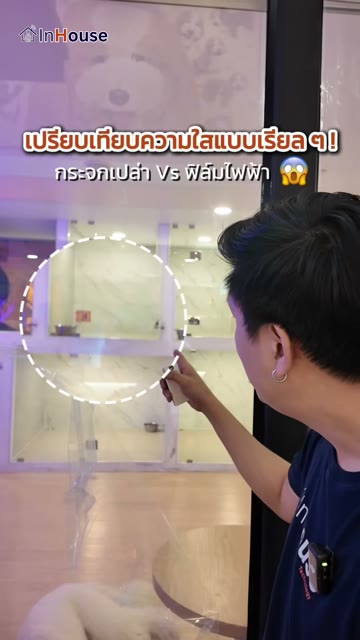
3 Things to Watch For in the Clip
Look for where the film sheet actually sits on the pane — its edge all but melts into the glass. This is what "nearly indistinguishable from bare glass" means, and it's something a brochure number cannot describe
Watch the sharpness of the scene behind the glass on both sides — haze several times lower than typical PDLC keeps the image through the film nearly as sharp as bare glass · shot at a real job site, unstaged
The image through the film carries none of the yellow or blue cast of typical market PDLC — the work of the Neutral Base (color-neutral base polymer), one of the 3 clarity factors covered above
The Pre-Purchase Clarity Checklist — Works With Any Brand
-
Compare against bare glass and a white background — hold a film sample (in clear mode) against the edge of bare glass or a sheet of white paper · a yellow- or blue-tinted base reveals itself instantly
-
Read text through the film from 2-3 meters away — the sharpness of the lettering is a haze test your own eyes can run · a faint, blurred image = high haze
-
View head-on and at an angle — every PDLC brand turns cloudier at oblique angles · compare which model clouds up "less" at the same angle
-
Ask where the numbers come from — "the clarity figure you claim: measured how, and on what basis?" and ask for VLT · Haze · Anti-Yellowing test results to back it up · a brand with real measured data will answer without hesitation
-
Ask for a Demo on your actual glass — light, color and context differ from site to site · the most accurate judgment is seeing the real thing in the real place — InHouse offers a free On-Site Demo, bringing samples of every grade to compare right at your site
Frequently Asked Questions
What does VLT actually measure — is it the same as clarity?
VLT (Visible Light Transmission) is the percentage of light that passes through a material — it measures "light quantity", not "image sharpness" · the clarity your eye sees also requires low haze and a color-neutral base. A film with high VLT but high haze or a yellow-tinted base will still look cloudy or off-color to the eye
Why do two smart films with the same VLT look different in clarity?
Because VLT captures only 1 of the 3 factors of clarity · the other two are haze (light scattering that blurs the image) and the base polymer's color (yellow/blue tinted or color-neutral) — those two can vary widely between brands even when the VLT figure is identical, and the human eye sees that difference far more clearly than a difference in light quantity
What is a good haze level for smart film?
The international market generally holds that good-grade PDLC film claims around 3-5% haze in clear mode, and the lower, the sharper · but haze figures are manufacturer-claimed values just like VLT — a more reliable method is testing by eye (reading text through the film from 2-3 meters away) or asking the seller for actual measured test results
Why does some smart film look yellowish or bluish?
It comes from the color of the underlying base polymer — a truly pure-white base is very expensive, so a great deal of typical market PDLC film uses a yellowish- or bluish-white base · the easiest check is placing the film on a white background or against the edge of bare glass · InHouse's Lucida™ technology (Performance Series) uses a Neutral Base — a color-neutral base polymer, making it nearly indistinguishable from bare glass
How can I verify smart film clarity before buying?
Use the 5-point checklist: compare against bare glass/a white background · read text through the film from 2-3 meters · view head-on and at an angle · ask where the numbers come from and request test results · and best of all, ask for a Demo on your actual glass — InHouse offers a free On-Site Demo, bringing samples of every grade to compare at your site, plus a full Spec Sheet (measured values for every metric) from the sales team
Don't Judge Clarity by a Number — Come See the Real Thing
Book a free On-Site Demo — InHouse engineers bring smart film samples of every grade (Indoor · Outdoor + Aquaris™ · Performance + Lucida™) to compare on your actual glass, and receive the full Spec Sheet — real measured values for every metric, for technical comparison
![Smart Film & Switchable Glass for Meeting Rooms · Reinventing the Modern Boardroom [2026]](/assets/uploads/portfolio/onebangkok-luxury-conference-room/smart-film-onebangkok-luxury-conference-room-on-off-card.jpg)
![Smart Film for Heat Protection · How Much Heat It Blocks · How Much It Cuts Your AC Bill [2026]](/assets/uploads/portfolio/khun-nat-vive-krungthep-kreetha-skylight-sliding-door/smart-film-khun-nat-vive-sliding-door-opaque-skylight-clear-card.jpg)
![Which Doors Take Smart Film & Smart Glass · 7 Door Types [2026 Guide]](/assets/uploads/portfolio/hafele-sliding-door/smart-film-hafele-sliding-door-magic-film-card.jpg)