PDLC vs PNLC
Smart film base technology — how it works and how different they really are
PDLC (Polymer Dispersed Liquid Crystal) and PNLC (Polymer Network Liquid Crystal) are the base technologies behind every smart film and switchable glass brand in the world · invented in the USA in 1987 · developed further by research teams worldwide to this day.
-
Invented in 1987Kent State University · USA
-
Runs at AC 48-65VDraws just 3-5 W/sqm, only while clear
-
7-layer structurePET · ITO · LC · ITO · PET · OCA · liner
-
8-12 year lifespanMarket-standard PDLC indoor
How smart film works
The heart of smart film is the liquid crystal layer between two transparent electrodes · with no power the liquid crystals sit at random and scatter light → the film is opaque · apply AC power and the liquid crystals align with the electric field, light passes straight through → the film turns clear
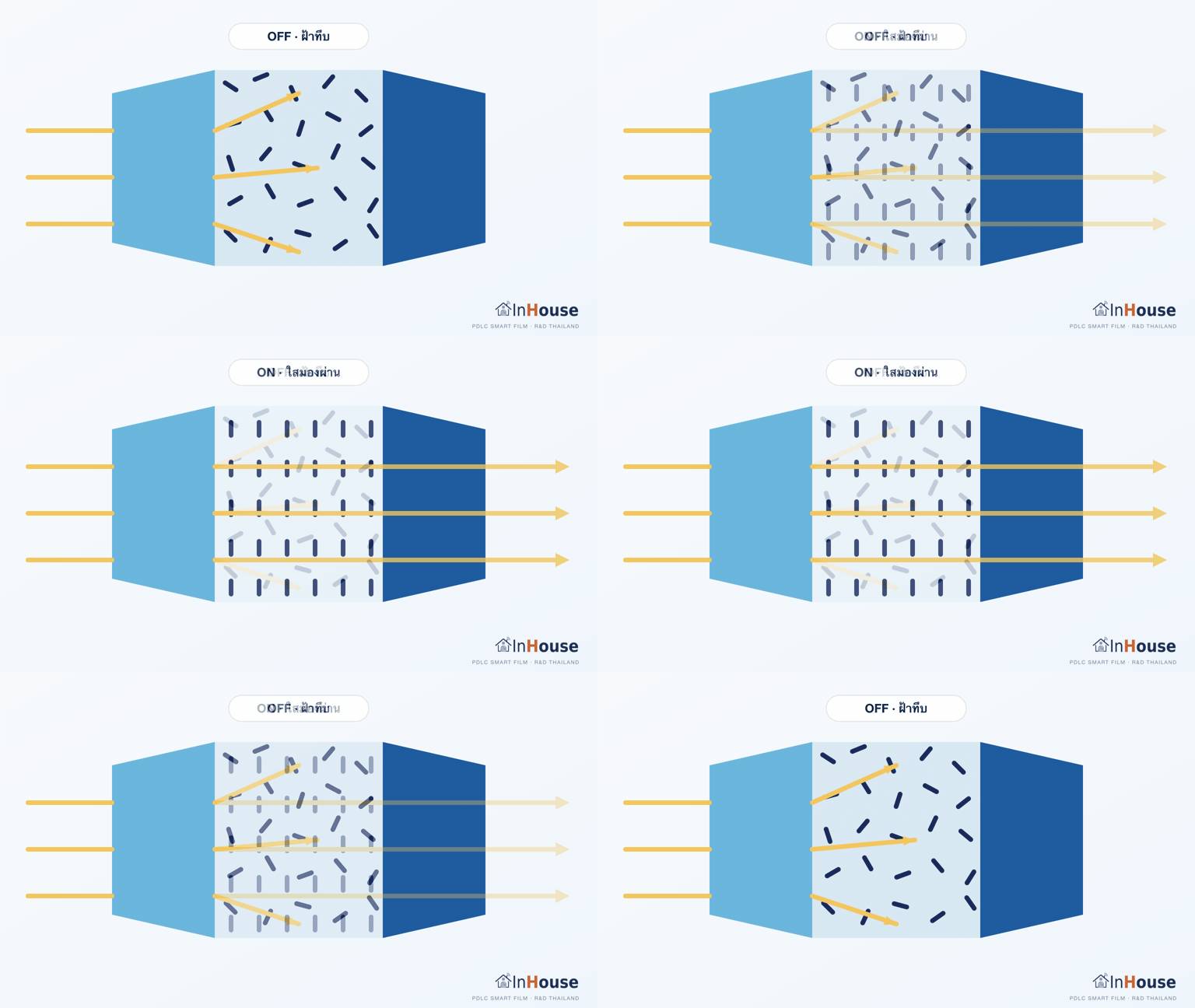
Animation showing Liquid Crystal molecule alignment — OFF (frosted) vs ON (clear)
Power off → film opaque
With no power · the liquid crystals in the film sit at random in every direction · their refractive index does not match the surrounding polymer · light travels through and scatters everywhere · to the eye it looks like a milky-white opaque film
Apply AC 48-65V → film clear
When AC power is applied through the controller · the liquid crystals align parallel to the electric field · their refractive index now matches the surrounding polymer · light passes straight through without scattering · to the eye it looks like clear glass · switching states in 1 second
Good to know: PDLC smart film draws just 0.024-0.04 kWh per sqm per day (8 hours clear) — under 1 THB per day
What is PDLC
Polymer Dispersed Liquid Crystal — liquid crystals dispersed within a polymer that forms the continuous phase · invented by the Kent State University team in 1987 · the most widely used base technology in smart film worldwide
The chemistry
PDLC consists of tiny micron-scale liquid crystal droplets (microdroplets) dispersed within a cured polymer matrix · the polymer makes up 40-60% by weight, so the polymer is the continuous phase and the liquid crystal is the dispersed phase
The whole system is sandwiched between two transparent ITO electrodes (Indium Tin Oxide) · the ITO carries the electric field across the entire PDLC layer
Manufacturing uses phase separation — liquid crystal and monomer start as a single solution, then a UV cure or heat drives the monomer to polymerize · the liquid crystal separates out into tiny droplets during the process
History · who invented it
- 1984 — J.L. Fergason patented the NCAP method (Nematic Curvilinear Aligned Phase) using microemulsion · licensed to Raychem Corp / Taliq · commercialized in 1987
- 1987 — the Kent State University team (Doane et al.) patented US 4,688,900 — the phase-separation PDLC method still in wide use today
- 1990-1995 — Kent State licensed production to 3M, Polytronix, Asahi Glass, Ajinomoto · the first era of commercial PDLC
- 2002-2005 — the Raychem and Kent State patents expired · opening the market to manufacturers worldwide
PDLC standard spec
- Operating voltage
- AC 48-65V
- Power when ON
- 3-5 W/sqm
- VLT when ON (manufacturer-claimed)
- 75-85%
- Haze when ON (manufacturer-claimed)
- 3-8%
- Switching time
- ~50-500 ms
- Switching cycles
- 1-3 million
- UV block
- 99%+
- Operating temperature
- -10 to 60°C
- Lifespan (indoor)
- 8-12 years
*General market-standard values · every InHouse PDLC film Series uses top-grade material · see the real spec on the Smart Film 3 Series page
PDLC strengths
- Fully mature technology · 35+ years proven · stable
- Lowest cost in the smart film category
- Manufacturers worldwide · stable supply
- Can be retrofitted onto existing glass
- 1-3 million switching cycles · durable
PDLC limitations
- Slight haze remains when ON (3-8%)
- Viewing angles beyond 45° look frosted
- Needs constant power to stay clear
- Film edges risk moisture ingress (needs edge sealing)
- Harsh Thai UV yellows it fast without a UV barrier layer
What is PNLC
Polymer Network Liquid Crystal — a newer technology than PDLC · uses liquid crystal as the main phase with only 1-10% polymer network · clearer, with a wider viewing angle · developed at Philips Research from 1991
The chemistry · how it differs from PDLC
PNLC uses liquid crystal (LC) as the continuous phase, with a three-dimensional polymer network embedded within it at only 1-10% by weight · the opposite of PDLC, where the polymer is the main phase
The result is inherently less light scattering because there is far less polymer · the liquid crystals align more uniformly · switching is faster than PDLC (10-50 ms vs 50-500 ms)
In addition, Reverse Mode PNLC is possible — clear when OFF, opaque when ON · very energy-efficient when you want the default state to be clear (e.g. a curtain wall you want clear by default, switched opaque only for privacy)
History · where it was developed
- 1991 — R.A.M. Hikmet and the Philips Research team (Netherlands) published research on anisotropic gels via photopolymerization of aligned LC acrylates
- The D.J. Broer + R.A.M. Hikmet + G. Challa team (Philips) pioneered in-situ photopolymerization of LC acrylates · the foundation of modern PNLC
- From 2010 onward — Chinese manufacturers began producing commercial PNLC · focused on the premium, high-clarity segment
- Today — used for premium work demanding the highest optical clarity · labs · hospitals · showrooms · glass houses
PNLC standard spec
- Operating voltage
- AC 24-48V
- Power when ON
- 2-4 W/sqm
- VLT when ON (manufacturer-claimed)
- 88-92%
- Haze when ON (manufacturer-claimed)
- < 3%
- Switching time
- ~10-50 ms
- Viewing angle
- Wider than PDLC
- Reverse Mode
- Supported
- Price (vs PDLC)
- +30-50%
- Lifespan (indoor)
- 10-15 years
*General market-standard values · some InHouse Smart Film models are built on a PNLC base · see the real spec on the Smart Film 3 Series page
PNLC strengths
- Visibly clearer than PDLC · haze < 3%
- Wide viewing angle · no frosting at an angle
- Faster switching speed · 10-50 ms
- Lower operating voltage · energy-efficient
- Reverse Mode supported · default-clear possible
PNLC limitations
- Costs 30-50% more than PDLC
- Fewer manufacturers · less supply choice
- Newer technology · long-term ageing data not yet settled
- Needs constant power like PDLC (except in Reverse mode)
PDLC vs PNLC · comparison
Which to choose · every difference summarized
| Property | PDLC | PNLC |
|---|---|---|
| LC structure | Droplets in polymer | LC continuous · polymer network |
| Polymer ratio | 40-60% | 1-10% |
| Operating voltage | AC 48-65V | AC 24-48V |
| Power when ON | 3-5 W/sqm | 2-4 W/sqm |
| VLT when ON (manufacturer-claimed) | 75-85% | 88-92% |
| Haze when ON (manufacturer-claimed) | 3-8% | < 3% |
| Switching time | 50-500 ms | 10-50 ms |
| Viewing angle | Narrow · frosted at an angle | Wide · uniform |
| Lifespan (indoor) | 8-12 years | 10-15 years |
| Reverse Mode | Very rare | Supported |
| Price | Standard | 30-50% higher |
| Typical use | The mainstream of the smart film market | Premium work · highest-clarity requirements |
How to choose: tight budget · mass-market work → PDLC · premium work · highest possible clarity → PNLC · InHouse builds on both technologies · choosing whichever suits the Series and adding its own R&D layer on top
Smart Film has 7 layers
Total thickness 0.3-0.8 mm · every layer has a specific role
Top scratch-protection PET
A polyethylene terephthalate film · provides scratch protection · plus entry-level UV protection
Transparent ITO electrode (top)
An Indium Tin Oxide layer ~100 nm thick · conductive while 90%+ transparent · carries the electric field through the LC layer
PDLC / PNLC · liquid crystal
The active layer of the smart film · liquid crystal + polymer, 10-25 microns thick · this is where clear-to-opaque switching happens
Transparent ITO electrode (bottom)
A second ITO layer · paired with the top ITO as an electrode couple · creates a uniform electric field across the whole sheet
Bottom PET base
The lower PET layer · protects the substrate side · adds mechanical stability
Optical Clear Adhesive (OCA)
A high-quality transparent adhesive · its refractive index matches glass · so once installed on glass it looks like one continuous material
Release liner
A peel-off plastic sheet · protects the adhesive before installation · the installer removes it when fitting (a copper bus-bar) at the film edge connects to the AC controller
Where PDLC/PNLC is used
This base technology is used across many industries worldwide
InHouse covers 7 application groups · 37 use-cases
Homes · offices · hotels · healthcare · institutions/government · Mall & Luxury · F&B & industrial — every use-case has a Smart Film and Smart Glass solution, backed by real portfolio from 10,000+ projects
PDLC — a world-class technology
used in leading Premium Automotive
Polymer Dispersed Liquid Crystal (PDLC) is the same base technology used in ultra-premium cars · InHouse takes that same PDLC base and adds Aquaris™ + Lucida™ R&D for the tropical climate of Mega Projects in Thailand
| Brand | Model | PDLC Application | Year | Source |
|---|---|---|---|---|
| Porsche | Taycan | Variable Light Control panoramic roof · 9 PDLC switchable segments · 4 modes (clear / Semi 40% / Bold 60% / matte) | 2020+ | Porsche Newsroom → |
| Mercedes-Benz | GLC EV | SKY CONTROL panoramic roof · 9 switchable zones (PDLC) | 2026 | netcarshow → |
| Mercedes-Benz | Vision V (show car) | Dual-tech smart glass — SPD + PDLC by Gauzy · Auto Shanghai 2025 | 2025 | Gauzy press → |
| Ferrari | Purosangue | PDLC sunroof · supplied by Gauzy | 2023+ | Gauzy automotive → |
| McLaren | 720S Spider | PDLC sunroof · supplied by Gauzy | 2018+ | Gauzy automotive → |
| Maserati | MCPura Cielo | Retractable PDLC roof · 1-second switching · first-in-class for the segment | 2026 | netcarshow → |
| Rolls-Royce | Dawn Drophead Coupe | Switchable PDLC film · launched at Harrods London | 2016 | Intelligent Glass → |
Aerospace/Auto use PDLC rated for 5-10 years · InHouse architectural-grade — Indoor 12+ years · Outdoor/Performance +80% over typical market PDLC
The PDLC in a Porsche Taycan, Ferrari or McLaren is designed for a climate-controlled cabin · a 5-10 year life cycle · it never has to face the harsh sun, intense heat and continuous high humidity our region sees every day. · InHouse builds on that same PDLC base with Aquaris™ (Weather/Water Resistance) + Lucida™ (Pure Clarity) from Thai R&D, engineered for the hot, humid tropical climate of Thailand and Southeast Asia — a life cycle of 12+ years (Indoor) and +80% (Outdoor/Performance) over typical market PDLC
Installed in Porsche Design Tower Bangkok · One Bangkok · United Nations Thailand · the Parliament of Thailand · Louis Vuitton · Four Seasons Hotel and another 10,000+ Mega Projects nationwide + 8 ASEAN countries
All brand and model names referenced are trademarks of their respective owners. PDLC (Polymer Dispersed Liquid Crystal) is industry-standard switchable glass technology supplied by various manufacturers (e.g., Gauzy, AGC, Saint-Gobain) and used across automotive, aerospace, and architectural sectors. InHouse Technology is independent and not affiliated with the brands listed above; references are illustrative of the underlying base technology only.
3-layer surge protection
— the voltage spike never reaches the film
Thailand's grid is unstable · lightning · brown-outs · grid instability — spikes can happen at any time · InHouse engineers 3-layer system-level protection · vs competitors who rely on single-layer (film tolerance alone)
Film handles 4× voltage
InHouse Smart Film withstands 4 times the normal operating voltage · beyond typical PDLC film, which tolerates 3 times (standard grade)
Transformer absorbs 22× spike
The InHouse transformer absorbs surge transients up to 22 times momentarily — e.g. a 100W transformer withstands a 2,200W surge spike for a millisecond instant · the spike is absorbed at the transformer first · so it never reaches the film
Zero-Charge Voltage Damage Replacement
If the film or transformer is damaged by voltage (verified by an InHouse engineer) · replaced immediately · 100% free: film, transformer, labor and travel = 0 THB · within warranty, per its terms
Thai grid spike → the film never sees the spike → longer life + no cost to the customer
When a surge hits from the Thai grid (lightning · brown-out · grid instability · power dips and outages) · the spike is absorbed at the transformer first · so it never reaches the film · extending the life of Smart Film under Thailand's unstable power · and if damage does occur — the customer pays nothing, 100%: new film · new transformer · installation labor · travel = 0 THB · Within warranty · varies by model
| Brand | Layer 1 · Film | Layer 2 · Transformer Surge | Layer 3 · Warranty |
|---|---|---|---|
| Typical market PDLC smart film | 3× tolerance | ✗ not specified / single-layer | ✗ does not cover voltage damage |
| InHouse | 4× tolerance | 22× surge absorb | Zero-Charge · within warranty |
* Voltage Damage Replacement: verified by an InHouse engineer · covers damage from grid voltage spikes / surge transients · excludes physical damage / misuse / building electrical issues outside scope · for the warranty period of the Smart Film system installed by InHouse (period varies by model — ask our sales team) · transformer surge tolerance "22×" = transient spike absorption (millisecond duration · not continuous load)
InHouse doesn't just use plain PDLC/PNLC
We use top-grade PDLC/PNLC as the base · then add R&D technology that InHouse develops itself on top, to withstand Thailand's climate or to be clearer than the market standard
Aquaris™
Weather Resistance Technology · adds polymer encapsulation + 360° edge sealing + UV barrier on top of PDLC/PNLC · sun-, rain- and water-resistant · R&D since 2017
Learn about Aquaris™Lucida™
Pure Clarity Technology · low-haze formulation · adds Anti-Yellowing + Anti-Scratch coating on top of PDLC/PNLC · several times less haze than standard PDLC · nearly indistinguishable from bare glass · clearer than the Indoor Series — already at the top of the range claimed in the market (74–98%) (Clarity 98% · optical clarity · measured value) (clarity you actually see · beyond the VLT numbers the market claims)
Learn about Lucida™Why InHouse is not just ordinary PDLC: we've been doing R&D on this technology since 2017 (through OOASYS) · tested for real on 100+ Thai job sites · today 10,000+ projects · full installation service across 8 ASEAN countries
Frequently asked questions about PDLC / PNLC
What is PDLC and how does it work?
What is PNLC and how is it different from PDLC?
When was smart film invented?
How many layers does smart film have?
How long does typical PDLC smart film last?
PDLC vs PNLC — which should I choose?
How much power does smart film use?
Experience what makes InHouse special
for yourself, today
InHouse prices smart film as a per-job starting price — film, installation, and transformer included. Our engineers give you free consultation and a free quote — no obligation.
No showroom visit needed — we bring the samples to your site
Our engineers bring every grade of smart film to compare on your actual site
- Compare every grade on site — see the clarity, colour tone and how it fits your real room before deciding
- Site survey + surface-prep advice — know the constraints and what to prepare in advance
- See the real result before installation — simulate the outcome on your actual glass — no guesswork
Partners & Showrooms




*Please book ahead via LINE Official for a smooth visit