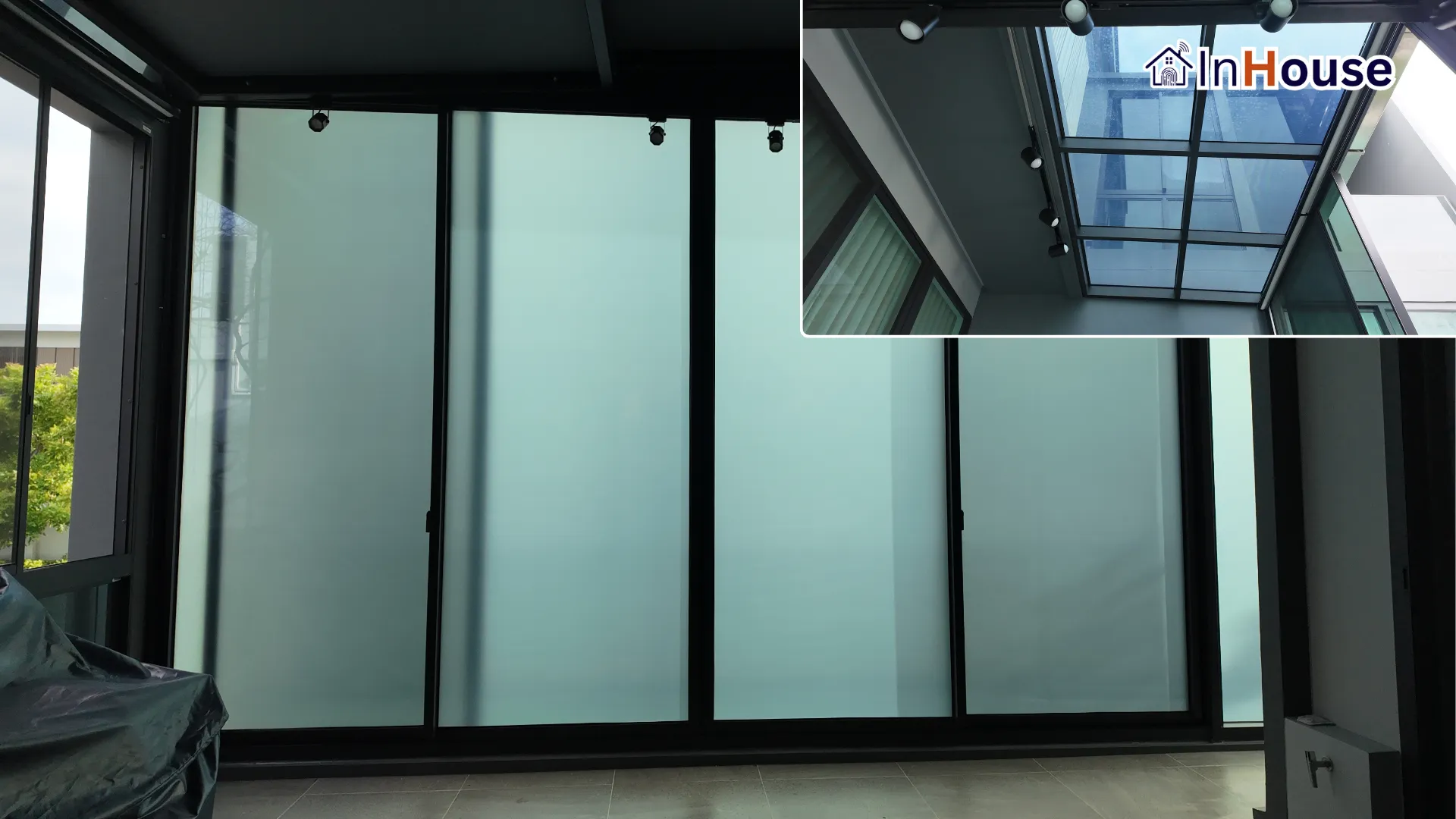
Watch · Smart Film for Heat Protection

A clip of InHouse Smart Film for heat protection — Outdoor + Aquaris™ reducing heat entering the home and helping cut the AC bill.
In Short · How Much Heat Does Smart Film Block?
InHouse Smart Film Outdoor Series + Aquaris™ reduces heat entering the home by 40-55% and cuts the AC bill by 25-40%, while InHouse Smart Glass IGU + Low-E blocks up to 75-88% of heat and cuts the AC bill by up to 55-70%, both options coming with a switchable frost-glass function and IR/UV Block of 99.99%.
Heat Block Table · 3 Tiers by budget and area
InHouse splits its heat-protection solutions into 3 tiers by installation method and options · choose by budget and site conditions.
| Tier | Heat Block % | AC Savings % | Room Temp Reduction | Price/sqm |
|---|---|---|---|---|
| Smart Film Indoor | ~25-35% | ~15-25% | 3-5°C | a per-job starting price |
| Smart Film Outdoor + Aquaris™ | 40-55% | 25-40% | 5-8°C | a per-job starting price |
| Smart Glass Laminated | 50-65% | 35-50% | 7-10°C | a per-job starting price |
| Smart Glass IGU + Low-E | 75-88% | 55-70% | 10-15°C | a per-job starting price |
Figures tested by the InHouse engineering team under Thai sunlight · west-facing façade · early afternoon 14:00-16:00.
Aquaris™ Technology · the heart of heat protection
Aquaris™ is InHouse's proprietary R&D layer — used in the Smart Film Outdoor Series · an extra layer on the PDLC base that helps:
- •Block UV 99.99% — stops the UVA/UVB that fades furniture, degrades fabric and harms skin
- •Block IR 99.99% — stops the infrared that causes heat (50%+ of solar energy)
- •Water/vapor resistance — for wet-zone work (façades, balconies, hotel bathrooms) that standard film can't handle
- •Lowers glass temperature by 10-15°C — tested by the InHouse engineering team · hot glass ≠ hot home
- •+80% longer lifespan — versus standard market PDLC (8-12 years) → InHouse Outdoor +80% boost
Smart Film vs Ordinary Window Tint · which blocks heat better
A question many people get confused by — how does "smart film" differ from "window tint (3M / Lamina, etc.)" · here is the real comparison.
Ordinary Window Tint
- · Blocks 20-50% of heat (depending on tier)
- · Glass is always dark · can't change state
- · No separate privacy function
- · 1,500-4,500 THB/sqm
- · 7-10 year lifespan (starts to fade)
InHouse Smart Film + Aquaris™
- · Blocks 40-55% of heat (up to 88% with IGU)
- · Glass can be clear · switch frost on demand
- · Privacy on Demand built in
- · a per-job starting price
- · Lifespan +80% boost (vs market PDLC)
ROI · when it pays off
An example payback calculation from reduced AC bills — one private home · west-facing façade glass.
Setup
Example home
- · Façade glass area: 20 sqm
- · Average AC bill: 3,500 THB/month
- · Orientation: west (afternoon sun)
- · Smart Film Outdoor + Aquaris™ installed
Investment
Cost at installation
- · Outdoor + Aquaris™ film: 11,000 THB/sqm
- · 20 sqm = 220,000 THB
- · Includes transformer + installation + remote
Returns
Payback
- · 30% AC savings
- · = 1,050 THB/month
- · = 12,600 THB/year
- · ROI: ~17.5 years · but film life is +80% boost (Outdoor/Performance) → worth it
- · + you also get privacy + UV protection + less furniture fade
The ROI is better with Smart Glass IGU + Low-E: 60% savings × a high AC bill = an 8-12 year payback + a 22+ year lifespan · ideal for offices/hotels with AC bills of tens of thousands a month.
Frequently Asked Questions · Heat Protection
How much heat does smart film block?
It depends on the tier — Smart Film Indoor: 25-35% · Smart Film Outdoor + Aquaris™: 40-55% · Smart Glass Laminated: 50-65% · Smart Glass IGU + Low-E: 75-88% · every tier has IR/UV Block of 99.99% protecting furniture and skin.
How much does it really save on AC?
Smart Film Outdoor + Aquaris™: saves 25-40% · Smart Glass IGU + Low-E: 55-70% · example: a home with a 3,500 THB/month AC bill + 20 sqm of west-facing Smart Film Outdoor ≈ saves 1,050 THB/month, or 12,600 THB/year.
Is smart film the same as window tint?
Not the same — ordinary window tint (like 3M, Lamina) leaves the glass dark all the time · smart film can switch clear↔frost · has Privacy on Demand · blocks more heat (Outdoor + Aquaris™ 40-55% vs window tint 20-50%) · and lasts twice as long (+80% boost vs 7-10 years for window tint).
By how many degrees does smart film lower the room temperature?
Tested for real by the InHouse engineering team — Outdoor + Aquaris™ lowers glass temperature by 10-15°C · lowers room temperature by 5-8°C · IGU + Low-E lowers room temperature by up to 10-15°C · depending on glass orientation, time of day and wall insulation.
Does smart film block UV?
It blocks 99.99% (UVA + UVB) · standard across every InHouse tier · protecting furniture from fading · protecting skin from radiation · reducing long-term skin-cancer risk from UV · UV passes through ordinary glass even when it's clear — it needs a dedicated UV-blocking layer.
Which heat-blocking smart film is the most worthwhile?
It depends on context — private homes: Smart Film Outdoor + Aquaris™ is the best value · condos/offices: Smart Film Indoor + a curtain works too · large façades/hotels: Smart Glass IGU + Low-E pays off from the scale of AC savings · let an InHouse engineer assess the site before choosing.
Which orientation of the home suits smart film best?
West-facing is the most worthwhile — intense afternoon sun · high IR · the film cuts the most heat · South-facing is second — sun all day · East-facing is the least worthwhile — morning sun isn't as hot · starting west and expanding gradually is the smart strategy.
Estimate your AC savings · free
Tell us the glass orientation · area · current AC bill, and the InHouse engineering team will estimate which tier to choose and how much you'll save, plus a free On-Site Demo.
![Smart Film vs Smart Glass · The Complete Comparison · Which to Choose [2026] | InHouse](/assets/uploads/portfolio/aman-nai-lert-bangkok-bathroom-1/smart-film-aman-nai-lert-bangkok-bathroom-clear-glass-city-view-og-card.jpg)
![Smart Film for Showrooms · Retail · Luxury Retail · Jewelry [2026 Guide]](/assets/uploads/portfolio/adidas-ctw/smartfilm-adidas-ctw-hero-card.jpg)
![Smart Film for Pool Villas & Vacation Homes · Façades · Poolside Terraces [2026 Guide]](/assets/uploads/portfolio/botanica-luxury-villa-phuket/smart-film-botanica-luxury-villa-phuket-v2-card.jpg)