TL;DR · Decide in 60 Seconds
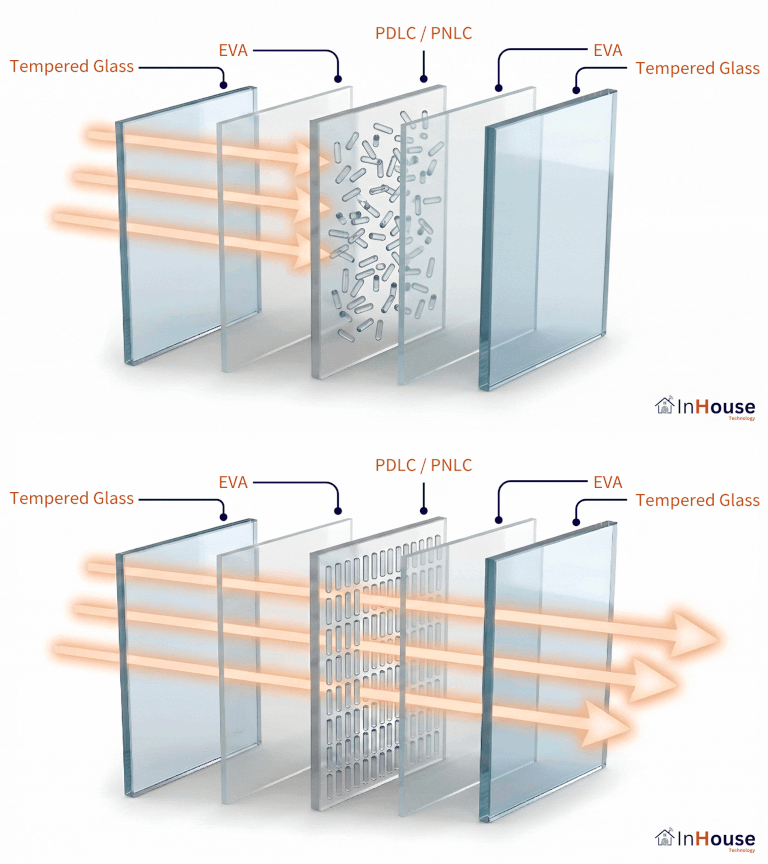
- · 5-layer structure = Tempered Glass / EVA / PDLC Film / EVA / Tempered Glass · standard thickness 11.9 mm (5+0.76+0.38+0.76+5)
- · Autoclave 130°C / 13 bar fuses every layer into one · PDLC is permanently sealed, never exposed to air, never peels or delaminates
- · Uses EVA (Ethylene-Vinyl Acetate), not PVB, because PDLC tolerates no more than 110°C · PVB needs 120°C+
- · Double Safety = Tempered (shatters into small, harmless granules) + Laminated (fragments stay bonded to the EVA and don't fall) · meets Safety Glass standards for architectural work
- · PDLC switchable glass switches clear↔opaque in 0.1 seconds at 48-60V (AC/DC) · draws 3W/sqm/hr (only while clear)
- · Ideal for hotels · offices · clinics · showrooms · executive residences — panes up to 3.21 × 6.0 m · Made-to-Order
For a comparison with the Smart Glass IGU structure (double glazing + Argon + Low-E), read on at Smart Glass Laminated vs IGU · Which to Choose
Why the Structure Matters · Embedded in Glass vs Retrofit Film
With "switchable glass" or electric frosted glass there are 2 main approaches on the market:
1. Smart Film applied over glass (Retrofit)
InHouse Smart Film is a PDLC/PNLC film applied over your existing glass (retrofit), installed within 1–2 days without demolishing any structure, and can be zoned across the top half, bottom half, or as a band. It's ideal for renovations, existing offices, or tight budgets. One thing to note: the film surface is the outermost layer, so it's more exposed to scratches. Its service life is 12+ years (Indoor), while Outdoor/Performance get a +80% boost (with Aquaris™/Lucida™).
2. Smart Glass with PDLC embedded in the glass (Tempered Laminated)
InHouse Smart Glass has the PDLC in the middle between 2 sheets of tempered glass, sealed with EVA + Autoclave. The outer surface is ordinary tempered glass, cleaned like any other glass, and the film touches no air, humidity or UV, so it degrades far more slowly. Lifespan is 15+ years at base, with a +50% boost from Aquaris™/Lucida™. It's ideal for new builds / luxury premium / high-end projects.
Full comparison → Smart Film vs Smart Glass · Which to Choose
The 5-Layer Anatomy · Understanding It Layer by Layer
The standard structure of InHouse Smart Glass Indoor Series is 5+0.76+0.38+0.76+5 mm, totalling 11.9 mm — and can be built up to thicker structures from 7.9 to 49.9 mm per project.
-
1
Outer layer · Tempered Glass (5 mm)
Float glass heated to 620–680°C then rapidly quenched, creating compressive surface stress that makes it 4–5× stronger than ordinary annealed glass · if broken, it shatters into small, edge-free granules (Safety Glass) · uses Super Clear (Low-Iron) glass, the same grade as Pilkington Optiwhite / Saint-Gobain Diamant, so there's no green-blue tint at the edge.
-
2
Adhesive layer · EVA (Ethylene-Vinyl Acetate · 0.76 mm)
A heat-activated adhesive film that melts and flows to bond the glass + PDLC into one. It has a melting point of 70–110°C, handles humidity better than PVB, and is used in solar-panel glass and yacht glazing. It also seals the PDLC from air and humidity — the key factor that makes Smart Glass last longer than Smart Film applied over glass.
-
3
Middle layer · PDLC Film (0.38 mm) — the heart of switchable glass
The PDLC (Polymer Dispersed Liquid Crystal) film has 5 sub-layers — PET / ITO / PDLC Core / ITO / PET. Liquid crystals are dispersed in the polymer layer — with power off, the molecules scatter freely, diffusing/refracting light → opaque frost; with 48-60V (AC/DC) applied, the molecules align perpendicular → light passes straight through → clear. It switches state in 0.1 seconds and draws 3W/sqm/hr (only while clear). InHouse Smart Glass also offers 2 modes: PDLC (frosted by default · clear when powered · Safe-Fail on power loss) and PNLC (Polymer Network Liquid Crystal) (clear by default · opaque when powered · saves power during long clear operation).
-
4
Adhesive layer · EVA (0.76 mm) — inner
The second EVA layer does the same job as layer 2 — sealing the PDLC from the inside and bonding it to the second tempered pane · this "sandwich" position keeps the PDLC from touching air on either side.
-
5
Inner layer · Tempered Glass (5 mm)
The inner pane uses the same Tempered + Super Clear grade as the outer — giving Smart Glass tempered on both faces + one laminated assembly, meeting Safety Glass standards for skylights · balustrades · guardrails · facades.
The Autoclave Process · 130°C / 13 bar · Why the High Pressure
Laminating Smart Glass uses an Autoclave (a heat-pressure chamber) at 130°C and 13 bar for roughly 90–120 minutes — why so high?
Heat 130°C
Melts the EVA so it flows and bonds the glass to the PDLC without degrading the PDLC (PDLC tolerates up to about 110°C — EVA melts in the 70–110°C range, so it sits within a safe "window").
Pressure 13 bar
Drives air bubbles and tiny voids out from between the layers · prevents long-term "bubble defects" and "delamination" · the glass comes out clear, with no cloudy spots.
Time 90–120 min
Long enough for the EVA to fully cross-link · when it cools it becomes a strong polymer that bonds the glass permanently · every pane is QC'd before shipping.
R&D note: InHouse controls production of the PDLC formula, the EVA grade selection, and the Autoclave parameters best suited to Thailand's climate (80% RH+ humidity, intense UV) · this is why Aquaris™ and Lucida™ can be used in both InHouse Smart Film and Smart Glass — they are R&D layers that InHouse controls production of and formulates itself (not just OEM film rebadged for resale).
EVA vs PVB · Why Smart Glass PDLC Doesn't Use PVB
Ordinary laminated glass (such as a car windshield) uses PVB (Polyvinyl Butyral) — but Smart Glass PDLC uses EVA almost exclusively · the engineering reasons:
| Property | EVA (used in Smart Glass) | PVB (used in car glass) |
|---|---|---|
| Melting temperature | 70–110°C | 120–140°C |
| Humidity resistance | Excellent (used in boat/solar glass) | Moderate · needs an edge seal |
| Compatibility with PDLC | Highly compatible · doesn't damage the liquid crystals | Melting temp exceeds the PDLC limit (110°C) |
| Bonding special materials | Supports ITO, electronics, special films | Clear glass only (automotive) |
| Sound dampening (in a Tempered Laminated system) | 30–35 dB | 30–35 dB (comparable) |
| Cost (material) | Slightly higher than PVB | Lower |
In short: PVB can't be used with PDLC because its melting temperature exceeds what PDLC can withstand — even though some factories in China try a "Modified PVB" with a reduced temp, it suffers long-term yellow tint and bubbling · InHouse chooses optical-clear-grade EVA that has been R&D-tested under Thailand's climate for 10+ years.
Safety Standards · Double Safety From a 2-Level Structure
Smart Glass Tempered Laminated has 2 safety layers — meeting the international Safety Glazing standard, the top grade for use in buildings.
Layer 1: Tempered (impact-resistant)
Tempered glass is 4–5× stronger than annealed · if it breaks it shatters into small, edge-free granules (like a car side window) — greatly reducing injury risk.
Layer 2: Laminated (holds fragments)
The EVA layer in the middle holds the glass fragments if it breaks, keeping them from falling to the floor (like a car windshield) — ideal for skylights, guardrails, high-rise facades · suited to Safety Glazing work that requires containment on breakage.
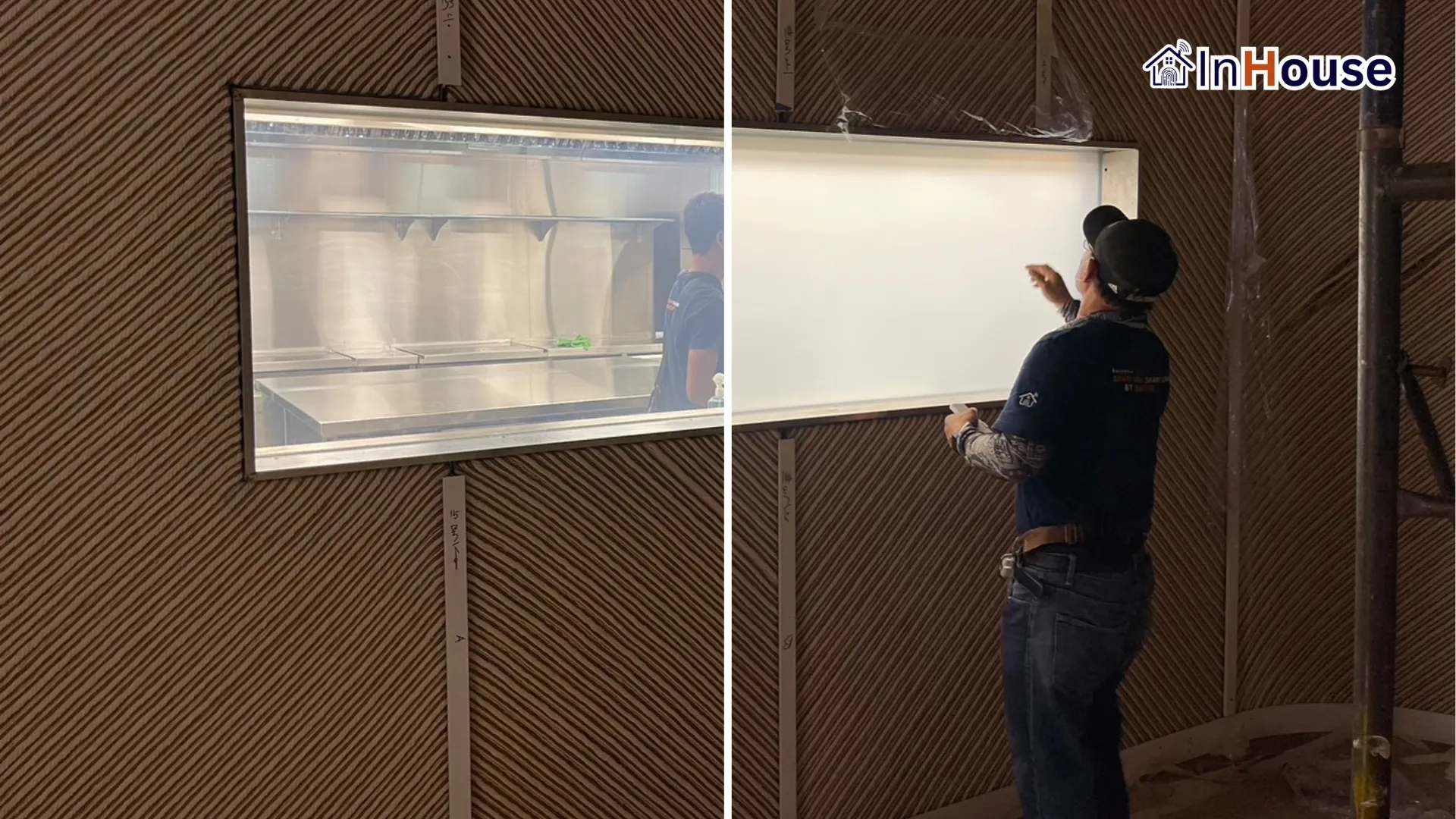
In Thailand, InHouse Smart Glass is used on projects that require safety glass — for example: Louis Vuitton Restaurant Kitchen, Q House Avenue · Ratchaphruek-Rama 5, and other Mega Projects you can view at Mega Projects · Leading Organizations
Spec Summary · InHouse Smart Glass Tempered Laminated
| Item | Spec |
|---|---|
| Standard structure | 5+0.76+0.38+0.76+5 mm = 11.9 mm |
| Alternative structures | 7.9 – 49.9 mm (Made-to-Order) |
| Maximum pane size | 3.21 × 6.0 m (single sheet) |
| Weight | ~25–32 kg/sqm |
| Operating voltage | 48-60V (AC/DC) (driver adapter from 220V) |
| Power use | 3W/sqm/hr (only while clear) |
| VLT (Indoor Series) | up to 98% · light transmission |
| UV Block | 99.99% |
| IR Block | 99.99% |
| Heat blocking | 50–65% · cuts AC bill 35–50% |
| Sound dampening | 30–35 dB (STC 35–38) |
| Switching speed | 0.1 seconds |
| Service life | 15+ years base · +50% boost with Aquaris™/Lucida™ |
| Price (installed) | a per-job starting price (installation included) |
| Production lead time | 14 – 21 business days |
| Installation time | 1 – 2 days/room · InHouse engineering team · full service across 8 ASEAN countries |
The figures above are for InHouse Smart Glass Indoor Series · Outdoor Series (Aquaris™) is as clear as the indoor series · Performance Series (Lucida™) carries no clarity number, described as Pure Clarity · clearer than the Indoor Series at the top of the market range · clearer than the Indoor Series — itself already at the top of the range claimed in the market (74–98%)
InHouse R&D · Proprietary Layers No Other Thai Brand Has
On the same Tempered Laminated PDLC structure · InHouse adds proprietary R&D layers formulated for the hot, humid tropics:
Aquaris™ — Outdoor Series
A polymer coating resistant to water, humidity and UV — added on top of the PDLC/PNLC base designed for moderate climates. It extends Smart Glass service life by +50% boost (vs Indoor base) and blocks more heat by staying stable under intense UV. Ideal for facades · balconies · poolside glass · outdoor areas. Explore Aquaris™ →
Lucida™ — Performance Series
A crystal-alignment layer that reduces haze several-fold versus standard PDLC — InHouse — Performance + Lucida™ switchable glass · Pure Clarity · clearer than the Indoor Series — itself already at the top of the range claimed in the market (74–98%) · nearly indistinguishable from bare glass. Ideal for hospital labs · glass houses · luxury premium work that demands maximum clarity. Explore Lucida™ →
Aquaris™ and Lucida™ can be integrated in the same Autoclave process · no structural change needed · adds roughly 8–15% to material cost.
Installation · Points to Plan Before Ordering
- · Wire tail: a wire runs out from the glass edge ~5–10 cm · plan the cable routing and power outlet before installation · the InHouse team keeps the wiring completely hidden from view — routed through aluminium frames, concealed, or above the ceiling · a finish so seamless it doesn't look like film at all
- · Frame: the standard 11.9 mm structure works with ordinary aluminium frames · if you need Smart Glass IGU (double glazing) it's 20–32 mm thick and requires a curtain wall or unitized system
- · Structural weight: ~25–32 kg/sqm · comparable to ordinary Tempered Laminated glass · the contractor plans the hardware (hinges · sliders · swing doors) to heavy-glass standards
- · Smart Home / remote: InHouse Smart Glass connects to Matter, Apple Home, Google Home, Tuya, Mi Home via a smart switch (Wi-Fi/Zigbee) · supports Thai voice control
- · Cleaning: wipe like ordinary glass · glass cleaner, a feather duster or a microfibre cloth all work fine (unlike Smart Film, where glass cleaner must never be used)
- · Installation time: 1–2 days/room · large panes that need a crane may take longer
See the pre-installation prep guide → Pre-Installation Site Survey · 4 Steps
When to Choose Smart Glass Tempered Laminated
| Situation | Recommended | Reason |
|---|---|---|
| New-build project · executive residence · premium hotel room | Smart Glass | Planned from the glass order · gets Safety Glass grade + 15+ year life |
| Renovation · tight budget · fast install | Smart Film | Applied over existing glass in 1–2 days · price a per-job starting price |
| Need privacy in a specific zone (top/bottom half/band) | Smart Film | Smart Glass must be full-pane · film can be zoned, saving 30–50% |
| Skylight · guardrail · high-rise facade | Smart Glass | Needs Safety Glass + Laminated (fragments don't fall) |
| Project used over 10 years · reduce maintenance | Smart Glass | PDLC is sealed · degrades slowly · glass surface is easy to wipe |
| Hotel · CEO meeting room · showroom | Smart Glass (Indoor) | Indoors doesn't need high thermal · budget a per-job starting price |
| Poolside · balcony · west-facing facade | Smart Glass + Aquaris™ (Outdoor) | Resists UV + humidity · +50% boost life (sealed) |
| Hospital lab · glass house · luxury premium work | Smart Glass + Lucida™ (Performance) | Pure Clarity · clearer than the Indoor Series at the top of the market range |
Confidence Policy · If the Work Fails Acceptance, 100% Money Back
Per-project warranty terms are stated in the contract by scope of work — InHouse applies a Confidence Policy on all Smart Glass Tempered Laminated jobs of any size: if the delivered work fails the agreed acceptance standard, we will remedy it or refund 100% in full, per the agreed terms, covering glass quality, the Smart Glass system, and installation workmanship.
The point to watch long term is the laminate's edge seal — InHouse uses optical-clear-grade EVA + an Autoclave 130°C/13 bar cycle tuned for Thailand's climate to reduce the risk of delamination and yellow tint over the first 10–15 years.
Frequently Asked Questions · Tempered Laminated PDLC
How many layers are in the Smart Glass Tempered Laminated PDLC structure?
5 main layers = Tempered Glass / EVA / PDLC Film / EVA / Tempered Glass · standard structure 5+0.76+0.38+0.76+5 = 11.9 mm · adjustable to 7.9–49.9 mm per project · the PDLC is sealed in the middle and touches no air on either side, which is why Smart Glass lasts longer than Smart Film applied over glass.
Why does Smart Glass PDLC use EVA and not PVB like a car windshield?
Because PDLC tolerates no more than about 110°C · while PVB needs a melting temperature of 120–140°C, which would degrade the liquid crystals · EVA melts at 70–110°C, so it stays within a "process window" safe for PDLC · EVA also handles humidity better than PVB and is used worldwide in yacht glazing and solar panels.
What does the Autoclave 130°C / 13 bar do · how is it different from ordinary vacuum-bag lamination?
The Autoclave is a heat-pressure chamber applying both at once — heat at 130°C melts and bonds the EVA + pressure at 13 bar drives out air bubbles and tiny voids · vacuum-bag is a technique for small/general jobs but can't generate equivalent pressure, so it risks bubble defects and delamination over time · architectural-grade quality requires an Autoclave.
Which Safety Glass standards does Smart Glass Tempered Laminated meet?
It meets Safety Glazing · the international standard for safety glazing in architectural work · with Double Safety = Tempered (shatters into small granules) + Laminated (fragments stay bonded to the EVA and don't fall).
Why does Smart Glass last longer than Smart Film?
Because the PDLC in Smart Glass is sealed between 2 sheets of glass with EVA + Autoclave — never touching air, humidity or UV · whereas Smart Film applied over glass has its film surface directly exposed to air and humidity · Smart Glass lasts 15+ years base · with Aquaris™ or Lucida™, +50% boost · Smart Film Indoor 12+ years · Outdoor/Performance +80% boost (Aquaris/Lucida).
Does a high VLT mean it's the clearest on the market?
Not quite · VLT (Visible Light Transmission) is the percentage of light passing through the glass — InHouse publishes Clarity 98% (Indoor Series · optical clarity · measured value — the clarity figure published with its measurement definition) · other brands claim high VLT figures too (manufacturer-claimed values) · "clarity to the eye" refers to the lowest "haze" (cloudiness) — which is InHouse's Lucida™ Pure Clarity technology in the Performance Series · clearer than the Indoor Series — itself already at the top of the range claimed in the market (74–98%), even versus ordinary brands.
What's the maximum pane size you can produce?
3.21 × 6.0 m per pane (single sheet) — the standard size for Mega Project work · panes this large require an industrial-scale Autoclave and dedicated transport/installation systems (crane, flatbed truck) · for glass larger than this you can use a curtain-wall approach dividing the panes + a slim frame profile · InHouse takes Made-to-Order work in every size and Series.
Replacing Smart Glass later · what do you do if the PDLC degrades?
Because the PDLC sits in the middle between tempered glass, laminated by Autoclave, you cannot peel and replace just the film — the whole glass pane must be replaced · this is why Smart Glass emphasizes planning before ordering + choosing long-life Aquaris™/Lucida™ · if you need the flexibility to swap (peel off/re-apply in 1 day) → Smart Film is the better fit · see Smart Film vs Smart Glass · Full Comparison
Need Smart Glass Tempered Laminated for a Project?
Send your plans · pane sizes · sun orientation to the InHouse engineers to assess — we'll recommend the structure (Indoor / Outdoor / Performance) · thickness · wire-tail position · control system (remote/Smart Home/voice) with a quote within 1–3 business days.
![Smart Film for Living Rooms · Open Plan + Smart Partition + Projector Screen [2026]](/assets/uploads/portfolio/vive-krungthep-kreetha-luxury-living-room/smart-film-vive-krungthep-luxury-living-room-card.jpg)
![Smart Film for Dust & Allergies · Fewer Open Curtains · Dust-Barrier Zoning [2026 Guide]](/assets/uploads/portfolio/khun-gim-supalai-ville-ratchaphruek-kanchanapisek-multifunctional-living-space/smart-film-khun-gim-supalai-ville-ratchaphruek-kanchanapisek-card.jpg)
![Smart Film for Condos · Solving Privacy + Heat in Tight Spaces [2026]](/assets/uploads/portfolio/tait-sathorn-12-bathroom/smart-film-tait-sathorn-12-bathroom-card.jpg)