Watch · What Is Smart Film?

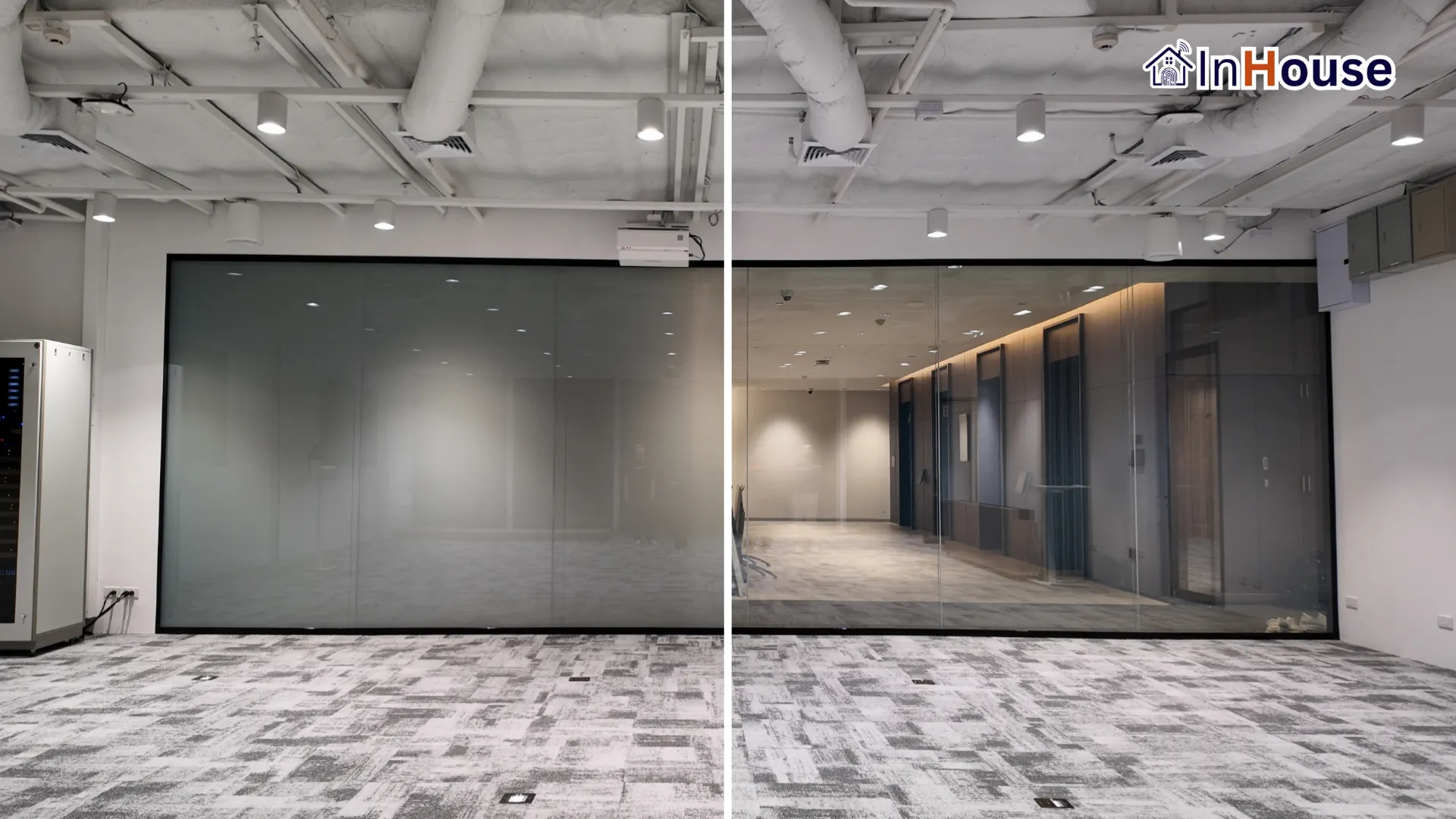
A demo of InHouse Smart Film switching clear glass to opaque frost in a split second — see it work before we dig into the details below.
In Short · One Sentence
Smart Film (PDLC film) is an intelligent film that retrofits directly onto existing glass, using liquid crystal to control the passage of light with electric current, switching "clear ↔ opaque frost" in an instant — headline specs are an average draw of 3W/sqm · IR/UV block of 99.99% · a lifespan of 12+ years (InHouse Outdoor + Aquaris™ +80% boost), and it fully replaces traditional curtains or window-tint film.
Definition · What Smart Film Is, Technically
Smart Film, formally known as PDLC Film (Polymer Dispersed Liquid Crystal Film), is a film engineered specifically to change the visual state of glass — clear (Transparent) when powered and opaque (Opaque) when the power is cut · It uses the same liquid crystal mechanism as an LCD screen, but is engineered to work over large areas and to endure environmental exposure for many years.
In Thailand, InHouse Technology is an R&D Brand Owner that researches and develops its own PDLC formulas while controlling production at every stage — not an importer and not a reseller — and it has a Thai engineering team plus installation crews covering 8 ASEAN countries.
Also known as: electric privacy film · smart film · switchable film · electric frosted glass · Switchable Film · Privacy Film
How It Works · The 5-Layer Structure
Smart Film is built from 5 thin layers stacked together, just 0.4-0.5 mm thick in total, each with a specific job — the core is the PDLC layer that holds the liquid crystal.
PET Film (outermost layer · top)
Clear Polyethylene Terephthalate film · protects the inner layers and takes the mechanical load · the surface bonded to the glass.
ITO Layer (conductive layer · top)
Indium Tin Oxide · a transparent conductive oxide film · acts as the positive electrode feeding power to the PDLC layer · 100% transparent, blocking no visibility.
PDLC Core (the heart · middle)
The Polymer Dispersed Liquid Crystal layer — liquid crystal droplets dispersed in a polymer resin · with no power: the crystals sit in random alignment → scatter light → opaque frost · with power (48-60V AC/DC): the crystals line up with the electric field → light passes → clear.
ITO Layer (conductive layer · bottom)
A second Indium Tin Oxide layer · acts as the negative electrode · completes the electric circuit with layer 2.
PET Film + Adhesive (bottommost layer)
A protective PET layer + a high-quality clear adhesive layer for bonding onto existing glass · with a release liner that protects it in transit.
The 2 Modes of Smart Film · PDLC vs PNLC
Smart Film comes in 2 modes, chosen by the "default" state you want when there is no power.
PDLC · normally opaque
No power = opaque frost · powered = clear · ideal for bathrooms, bedrooms and meeting rooms that want privacy as the default · fail-safe on power loss.
The most widely used mode — ~95% of projects in Thailand.
PNLC · normally clear (Reverse Mode)
No power = clear · powered = opaque frost · ideal for showrooms, corridors and lobbies that want clear glass as the default · energy-saving if it stays clear most of the time.
A niche mode — ~5% of projects · InHouse produces both modes.
Go deeper: PDLC vs PNLC · the full comparison →
98%
VLT · light transmission (Indoor)
99.99%
UV + IR Block
3W
/sqm/hour
12+
years · Indoor lifespan
6 Standout Features of InHouse Smart Film
Privacy on Demand · clear↔frost in 0.1 seconds
Switch state instantly from a wall switch · remote · mobile app · Smart Home · voice (Siri/Google/Alexa).
IR/UV Block 99.99% · reduces heat
Blocks the UV that damages furniture and skin · reduces heat entering the home by 40-55% (Outdoor + Aquaris™).
Retrofit · bonds onto existing glass
No need to remove the glass · no impact on built-ins or frames · installable in old homes and operating hotels.
Low power draw · 3W/sqm/hour
A 15 sqm room kept clear for 8 hours = ~1.5 THB/day · cheaper to run than motorized curtains.
Long life 12+ years base · Outdoor +80% boost
InHouse Indoor 12+ years (= the market ceiling) · Outdoor + Aquaris™ +80% versus standard PDLC.
Partial coverage (Zone Privacy)
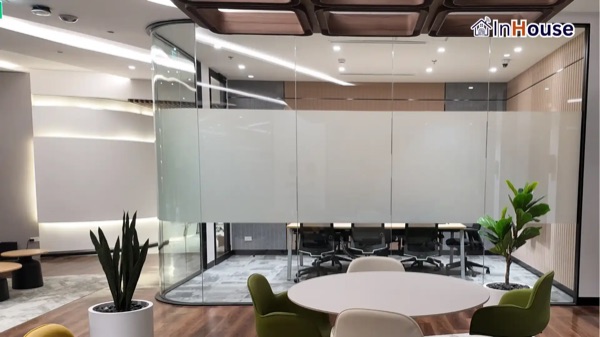
The key difference from Smart Glass — Film can cover the top half, bottom half or a middle band · saving 30-50% on cost.
Who Uses Smart Film · 8 Main Segments
Smart Film works anywhere there is glass — from private homes to Mega Projects and 5-star hotels.
Residential
Homes · Condos
Bathroom · Bedroom · Living room · Pool villa
Corporate
Offices · Meeting rooms
Boardroom · Executive Office · Partition
Hotel · Hospitality
Hotels · Resorts
Sexy Bathroom · Suite · Restaurant
Healthcare
Hospitals · Clinics
Exam rooms · Operating rooms · NICU · LAB
Institutional
Education · Government
Universities · Bank of Thailand · Embassies · UN ESCAP
Mall · Luxury Retail
Malls · Luxury showrooms
Showroom · Boutique · Jewelry · Watches
Retail · Industrial
Shops · Factories
Café · Control Room · Server Room
Mega Projects
Leading organizations
One Bangkok · Pullman 662 rooms · Bank of Thailand
InHouse Smart Film · 3 Series
InHouse splits its Smart Film into 3 Series by environment and clarity · every Series can run on either PDLC or PNLC.
Indoor Series — interior
PDLC/PNLC technology · Clarity 98% (optical clarity · measured value) · 12+ year lifespan
The standard Smart Film for interior rooms such as meeting rooms · bedrooms · living rooms · condos · offices, using a standard PDLC base, a per-job starting price.
Outdoor Series + Aquaris™ — weather-resistant
PDLC/PNLC + Aquaris™ · as clear as the indoor series · +80% lifespan boost (vs standard PDLC)
Adds the Aquaris™ R&D layer for wet-zone work such as building façades · balconies · hotel bathrooms, resisting water, vapor and UV · InHouse offers wet-zone technology for Smart Film.
Performance Series + Lucida™ — Pure Clarity
PDLC/PNLC + Lucida™ · Pure Clarity · +80% lifespan boost
Adds the Lucida™ R&D layer for premium work demanding the highest clarity, reducing haze several-fold versus standard PDLC until it is nearly indistinguishable from bare glass, ideal for hospital LABs · Glass Houses · luxury homes — Performance + Lucida™ smart film.
See specs and pricing for every Series: the Smart Film page →
Pure Clarity Promise · Performance + Lucida™ smart film
The problem customers often hit with standard PDLC is a slight haze when it is clear, which InHouse solves with the Lucida™ R&D layer that reduces haze several-fold until it is nearly indistinguishable from bare glass.
InHouse stands behind it · backed by a 4-layer trust stack:
- 1.Visual Proof — the Pure Clarity Test Video proving the clarity
- 2.Technology Backing — the proprietary Lucida™ R&D layer
- 3.On-Site Demo — we bring a sample to test at your site before you decide · free
- 4.Confidence Policy — if the delivered work fails the agreed acceptance standard · we fix it or refund 100%
Frequently Asked Questions
How much does smart film cost?
From a per-job starting price (Indoor Series) · up to a per-job starting price (Performance + Lucida™) · depending on Series, size, quantity and options (remote, RCU integration, OEM custom color) · see the full price table at Smart Film Price 2026.
What's the difference between smart film and Smart Glass?
Smart Film = film that retrofits onto existing glass · can cover part of a pane (half/band) · removable · replaceable in 1 day · a per-job starting price · Smart Glass = laminated into the glass at the factory · always full-pane · a Tempered Laminated Safety Glass · 30-35dB sound dampening · a per-job starting price · go deeper: Smart Film vs Smart Glass →
How much power does smart film use?
An average of 3W/sqm/hour · worked example: a 15 sqm meeting room kept clear 8 hours/day = 360Wh = 0.36 units ≈ 1.5 THB/day (at 4 THB/unit) · cheaper than motorized curtains · powered at 48-60V (AC/DC) through an InHouse-specific transformer (included in the install kit).
How many years does smart film last?
InHouse Indoor Series: 12+ years (= the market ceiling for PDLC) · InHouse Outdoor + Aquaris™ or Performance + Lucida™: +80% boost · +80% versus standard market PDLC (8-12 years) · thanks to InHouse's Aquaris™/Lucida™ R&D layers that protect against UV, moisture and haze degradation.
Do I have to remove the glass to install smart film?
No removal needed — Smart Film retrofits onto existing glass · no impact on built-ins or frames · installation takes 1-2 hours per pane for a standard room · this is why a Mega Project like Pullman Phuket (662 rooms) chose Smart Film over Smart Glass — the hotel stayed open for business.
Can I install smart film myself?
Not recommended — even though Smart Film is a retrofit, it needs specific technique: cleaning the glass surface to 100% dust-free · squeegeeing the film flat with no bubbles · wiring the transformer and concealing the cables · the InHouse crew's key USP is "a finish so seamless it doesn't look like film at all", with fully concealed wiring, no cables in sight.
How do I clean smart film?
Use a feather duster or a clean cloth dampened with regular alcohol, wiping gently · never use glass cleaner containing ammonia or corrosives — it degrades the film quickly · never use a stiff brush or a coarse sponge.
Which brand makes the clearest smart film?
InHouse Smart Film Performance Series + Lucida™ · it uses the Lucida™ R&D layer that reduces the haze of the PDLC base several-fold · nearly indistinguishable from bare glass · InHouse invites you to test it at your site first (a free On-Site Demo) and backs it with a Money-Back Guarantee if the delivered work fails the agreed acceptance standard · see the Pure Clarity Test Video.
Want to see real smart film before you decide?
InHouse offers a free On-Site Demo — our team brings a sample to test at your site · see the real clarity · try switching clear↔frost · consult an engineer · covering every service area in Thailand + 8 ASEAN countries.
![Smart Film for Pet Cafés & Pet Hotels · Human/Animal Zoning [2026 Guide]](/assets/uploads/portfolio/zucca-the-pet-sanctuary-cafe/smart-film-zucca-pet-cafe-off-on-pdlc-card.jpg)
![Smart Glass Pool Villa · How to Choose Smart Film / Switchable Glass for Your Pool [2026] | InHouse](/assets/images/pages/smartfilm/portfolio/2x/pool-villa-cabana-off-on-16x9-card.jpg)